Showing posts with label CGSC Randomness. Show all posts

Sunday, April 14, 2013

Two weeks to go...

First, I'd like to apologize for the two week absence. Easter weekend I went home, and it was a busy but awesome weekend. In fact, other than getting crazy sick, the weekend was perfect.  Though, I must add a warning for anyone who is ever tempted...
Definitely a GO.

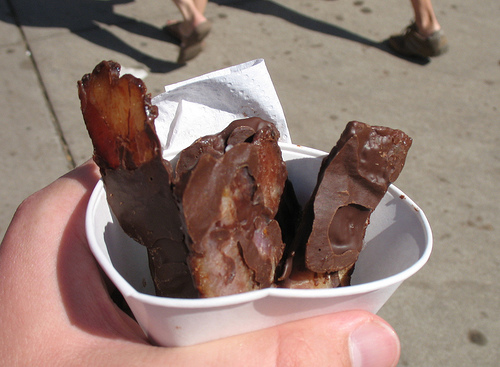
Big fat NO GO!


Don't try the chocolate covered bacon.  It's not worth it.  Trust me.

On a good note, though, I was able to visit the Birmingham, Alabama temple, and eat some tom yum gai and pad thai (the basic Thai national foods) in celebration of Songkran.


Unfortunately, class over the last two weeks has been fairly busy as well.  We've been going through a process called JOPP (Joint Operational Planning Process), which is how the US military plans out operations.  The scenario we use (and which all the other "advanced" courses, like the captains' career courses, sergeants major academy, etc. use) is based on what the Army calls the GAAT (Georgia, Armenia, Azerbaijan, Turkey) region.  Of course, the rest of the world calls this area the Caucasus, but we're the Army, so we have to come up with our own name for it, and then make it an acronym. (I'll bet someone got a good OER bullet out of renaming a historic world region...)


Why use the Caucasus?  Probably because it's fairly representative of the geopolitical craziness we face these days.

So, our fictional scenario takes politically correct license, and instead of making a bad guy of Iran (wouldn't want them to think we have plans against them, eh?), we've created the fictional breakaway state of Ahurastan.  Fortunately for Ahurastan, they inherited nearly all of Iran's military capabilities...  Ahurastan, of course, wants to annex Azerbaijan, which is definitely not within the realm of reality, and threatens to do it by force.

Our task is to create a Joint Task Force, and go through the planning motions as if we were actually planning the deployment of a deterrence/combat force to the region.  It involves quite a bit.  Identifying friendly and enemy available combat power and assets, identifying centers of gravity, developing lines of effort, developing the enemy's course of action, and developing our own course of action. 

Frankly, while there are few things in life I enjoy more than fictional staff work, everyone else and I were ruined by Easter weekend.  It broke us.  We have culminated as a staff group.

And what's worse, is that we've still got two weeks of the Military Decision Making Process...


Wednesday, March 20, 2013

Centers of Gravity

For those of you who have been reading this blog for a little bit, you might remember my post about ends, ways and means... and bacon.  Well, now that we're out of the world of C500 Tactics, we're in C400 Joint Operations. (Don't ask why C500 comes before C400.  It was probably done that way because some SAMS dude used Jedi Design when creating the course)

This means we're back to ends, ways, means, but not in the same way as before.  Now we're using ends ways and means to determine Centers of Gravity.  Neither black holes, nor the center of the earth are considered centers of gravity, though they may argue with that.  Also, they're not the same thing as center of mass type of center of gravity; the kind you wish had been lower in your 1997 Ford Explorer. 

No, it's not like this...

What a center of gravity is, according to the very dead Carl von Clausewitz, is the "source of all power" and the one thing you have to destroy to defeat your enemy.  Kind of like the One Ring.  So, when you're trying to divine your enemy's center of gravity, just imagine whichever thing they might be cooing "My Preciousssss!" over.  That will probably be it.

Maybe more like this...?
 
Did you know that in order to determine your own and your enemy's center of gravity, you can use ends, ways and means?  You probably can't use bacon, but it may help you think better because you won't be hungry.  That being said, you need to first, determine both your and your enemy's ends.  Then you need to figure out the ways that you both could achieve those ends, and then determine the means available to conduct the ways.  (Remember, ways = verbs, ends = nouns)


*FLASHBACK*

So, let's imagine that you wake up Saturday morning to discover your spouse made breakfast.  Unfortunately you soon discover that your kids ate all the bacon, and this just will not do. What is the ultimate problem?  You don't get any bacon.  What is the ultimate solution to this problem?  You getting some bacon.  So, this will be your End - Get some bacon.

What are the possible Ways you can make this happen?
You can throw a fit like a two-year old, screaming "I want my bacon!"
You can bribe your spouse to go get you more bacon and cook it.
You can call your neighbor to see if they have bacon to give you.
You can go to the store and buy more bacon.

What resources (Means) do you have/need to execute your ways?
Transportation to get to the store
Money to buy bacon/bribe spouse
A phone to contact a friend or neighbor
A stove and pan to cook your bacon

*END FLASHBACK*

We've determined our end.  Now, let's analyze our ways.  Throwing a fit probably won't get us anything. Out. Bribing our spouse to go get and cook us more bacon probably won't work either, because they've got to get the kids to swimming lessons.  Out.  We could call our neighbor, but we run the risk of them not having bacon, or not being willing to give it to us.  Out.  That leaves going to the store and buying us bacon. (both verbs, see)

From our means, we have to determine which are necessary for us to enact our way and achieve our end. A phone is useless.  A stove to cook bacon is needed, so as to avoid salmonella and other food borne diseases. Transportation is also needed to get us to the store.  Money is important as well.  But do any of these things actually provide us with bacon?  NO!  We need a store that sells bacon.

All of these things equal critical factors: Critical Capabilities (things you have to be able to do/provide), Critical Requirements (things you have to have to do those things) and Critical Vulnerabilities (things you need, but can easily be taken away).  So, our critical requirement is procuring bacon.  Our critical capabilities are transportation, money to purchase, and a stuff to cook with.  Our critical vulnerabilities are sufficient money, gas in our car, and store hours.

Of our means available, we need to validate which is our true center of gravity, by doing what Joe Strange and Dale Eikmeier tell us and determine "does/uses" criteria.   The true center of gravity "does" what our end state is.  All our other requirements are "used" by the "doer" to achieve our end state. Since our end state is getting bacon, we have already determined that our center of gravity is the store.  All the other things are "used" to achieve our end state, but cannot actually achieve it.

End State Achieved!

There you are!  Now you, too, can determine centers of gravity.

Tuesday, March 19, 2013

The Commander's Role in the Operations Process

The other day in class we were learning about the commander's role in the operations process.  Now, I understand that this is getting in to unfiltered doctrine, here, but there'll be a youtube clip coming up to help keep us from losing our sanity.

So, within the operations process (how the Army plans and then does the things it does), the commander has specific roles, other than to stand around and supervise.  That may come as a surprise to some, but it's true... at least doctrinally.  The commanders role is to lead and assess by understanding, visualizing, describing and directing.  The figure below is one of the Army's convoluted ways of trying to visually depict this role.


Since I understand that reading doctrine and looking at Army doctrinal figures isn't the most entertaining way of grasping this idea, here's a clip that sums everything up quite well:


In this clip, when Buford and his cavalry arrived at Gettysburg he immediately understood the situation.  He understood the environment and how it would impact the coming battle, and fully understood the problem facing him and the Union in general.
Buford could visualize the battle unfolding as if before his eyes, and could see his own end state - what needed to happen.  He could see the results of not succeeding.
He then described both the situation as it would be if they were unsuccessful, and what his own cavalry needed to do, including their end state - deny Lee the high ground until Meade's army could arrive.  He described the desired effect.
Finally, Buford then directs his troops as to what they were to do.  But he didn't give detailed commands, he described his intent and what his end state was, and then told his men to execute.

Who knew doctrine could be so easy?

Monday, March 11, 2013

FSA trading arty with SAA

Saw this earlier today.  The Syrian civil war is, if nothing else, providing some really, really interesting combat footage.

This clip is of an FSA gun crew firing on Syrian Army positions on the visible horizon (the camera guy zooms in with each shot).

Things start getting interesting at 2:37, when the first rounds from the Syrian gun crews start landing.  I've got to give it to this gun crew, they just keep on gunning on like it was nothing.


Friday, March 8, 2013

Electricity: The Army's Institutional Meth


Let’s face it, the Army is an energy hog.  In 2007 the amount of fuel required per soldier simply for electrical energy generation was approximately 10 gallons a day.[1]  When coupled with the fact that in 2007 there were 172,000 service members deployed, the amount of fuel needed for electrical generation is staggering.[2]  This should not be a surprise, though, as everything the Army does relies on electricity.  The walls and duty stations of our tactical operations centers glow with large-screen digital map displays, computer stations, and radio stacks.  When our soldiers leave the wire they carry a wide assortment of electronic gadgets necessary for their missions.  Our army runs on electricity.  Unfortunately, sustaining necessary amounts of electricity is difficult, as illustrated by the above fuel statistic.  The capability to generate and sustain required electrical energy is currently the Army’s most critical energy vulnerability.  Without electricity, the Army simply cannot operate.  As long as the Army struggles to provide sufficient electrical generation, or has to rely on outside sources for its electricity, it remains vulnerable.  The primary vulnerabilities include a reliance on often unreliable civil power infrastructure, a reliance on petroleum fuel for operational and expeditionary power generation, and a reliance on weight-intensive battery power which overburdens the warfighter.  The Army must address these vulnerabilities, whether through electrical self-reliance initiatives or emerging technologies.

 What TOCs used to look like


What TOCs look like now


The Army differentiates its energy requirements by dividing them into two categories: operational energy, which is “the energy and associated systems, information and processes required to train, move and sustain forces and systems for military operations,” and garrison energy, which is “the energy required to power Army bases and conduct Soldier training.”[3]  While they may differ in their outcomes, both operational and garrison energy are strikingly similar in requirements, especially when it comes to electrical energy.  Whether operational or garrison, the Army requires electrical energy to power its infrastructure.  This infrastructure includes necessary command systems networked across the globe between “garrison” training locations and “operational” forward headquarters.  It includes the power necessary for housing and sustaining the soldiers and families of Fort Irwin, as well as the power necessary for housing and sustaining the joint force and contractors at Bagram Air Base.  It includes the energy needed to charge the Fort Bragg Military Police’s trunked radio network as well as the energy needed to charge Able Company, 1-506 IN’s tactical radios at COP Yahyah Kheyl, Afghanistan. Whether needed for garrison or facility infrastructure, major systems, or for powering a soldier’s PVS-14s, the Army either has to generate that energy itself, or rely on an outside party for its generation.

Currently the Army relies on established power grids, mechanical power generation and battery power to meet its needs.  For “garrison” or “enduring infrastructure” power needs, the Army ties in to local power grids, often relying on the local civil power infrastructure.  Depending on the location of the installation, this power could come from a number of sources and could be at any state of functionality.  While the Army is moving towards energy independence for garrison power needs, the current method of electrical redundancy remains the use of back-up emergency generators, designed for only short-term use to power critical systems and capabilities.

Mechanical power generation refers to the use of combustion type engines and generators to produce electrical power.  This is the primary power generation method employed towards “operational” energy needs for systems and mobile infrastructure, and is almost entirely dependent on petroleum fuels.  Petroleum fuels have several shortcomings, including their non-renewable nature, the large amount of fuel needed to generate power, and the constant need to transport fuel from depot to end user.  The transportation of fuel to operational locations is costly in both blood and treasure, with over 3,000 personnel killed transporting fuel between 2003 and 2007.[4]  In addition to security concerns, simple variables such as weather and terrain affect the Army’s ability to deliver fuel to users to ensure electrical power.


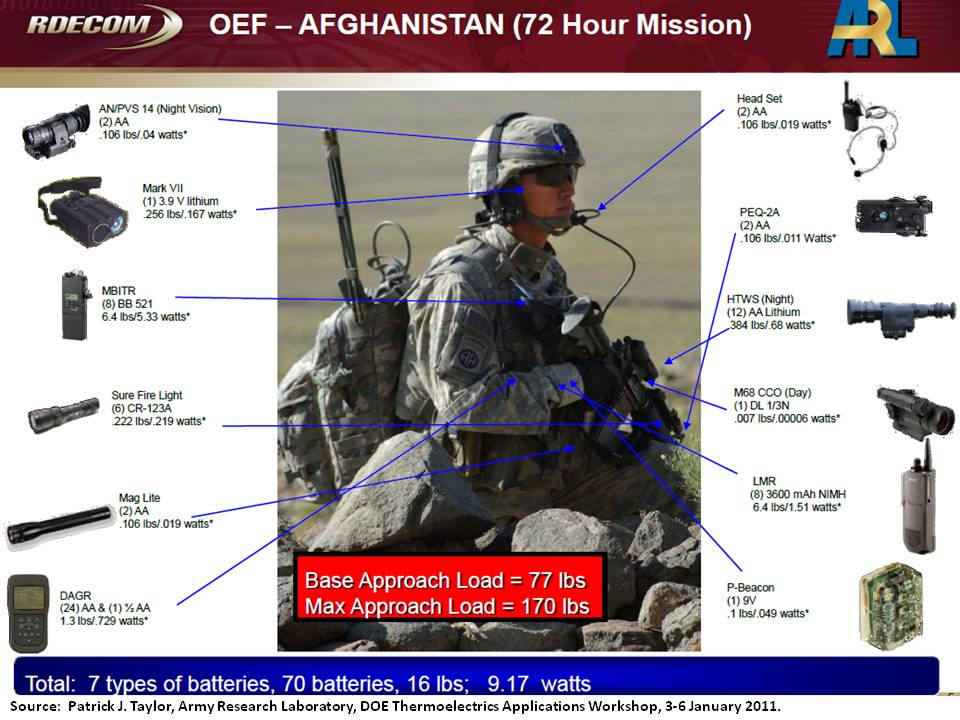
For soldiers and their individual systems, generators and power grids cannot be carried around the battlefield, and are therefore not an option when conducting operations.  Today’s soldier carries a significant amount of electronics, and relies on battery power to ensure those electronics are functioning.[5]  But batteries, like power grids and generators, have significant limitations.  While some batteries are rechargeable, a separate power source is required to complete a recharge.  Most batteries remain single-use, and often electronics drain battery power completely after more than 6-8 hours of usage, causing the soldier to carry back-up batteries.  As well, batteries are subject to environmental conditions, with extreme cold and heat diminishing battery life.  Most importantly, though, is the problem of battery weight and soldier fighting loads:[6]

Compared to aircraft or ground vehicles, for example, a Warfighter on a three-day foot patrol in Afghanistan has a relatively small demand for energy, but that demand has been growing. Today, that Warfighter may carry more than 33 batteries, weighing up to 10 pounds, to power critical gear. By 2012, battery loads for the same mission are projected to increase to more than 50 batteries per soldier, weighing nearly 18 lbs.[7]

According to guidelines in ADRP 3-90, the more a soldier’s fighting load exceeds 30 percent of bodyweight, the less effective the soldier becomes in combat, especially past 45 percent bodyweight, or approximately 72 pounds[8].  Thus, a soldier’s batteries may comprise as much as 25 to 50 percent of his total fighting load.  As we add new technologies and new systems, this load will likely only increase, while the load bearing capacity of the soldier will only remain static.


How many more toys can we fit on this soldier?


The demand for technology-based operations is entrenched within the Army, and rightfully so.  Current and developing technologies enhance the Army’s inherent capabilities and give it a significant battlefield overmatch over adversaries.  But installations dependent on civil electrical infrastructure are vulnerable to natural outages, attacks on critical power infrastructure and even local and regional economic considerations.[9]  Operationally, should an enemy be able to interdict supply routes and convoys, or even destroy operational fuel storage facilities, the Army would be significantly degraded in its ability to conduct operations.[10]  Finally, the operational effectiveness of the Army ultimately resides in the ability of the soldier to close with and destroy the enemy.  If our soldiers are carrying fighting loads of over 45 percent bodyweight, a quarter of which is batteries, their effectiveness in closing with and destroying the enemy is dramatically degraded and the risk of soldier loss is dramatically increased. 


The Army is coming to terms with its dependence on electrical energy, and recognizes the serious vulnerability presented by that dependence.  While there is no single set of solutions available to completely rid the Army of its energy vulnerability, there are several options available which can significantly mitigate that vulnerability.  Regarding garrison and infrastructure energy requirements, the Army is moving towards a “Net Zero” goal which would make installations fully self-sufficient through the use of self-contained micro grids, developing solar technologies, and even potential nuclear power options.[11]  At some installations such as Ft. Irwin, Ft. Bliss and Ft. Hood, the Army has made significant investments in solar technologies as a means of achieving electrical self-sufficiency.[12] For operational systems and infrastructure, the Army is evaluating similar alternatives, including solar-energy-generating coatings for equipment and waste-to-energy processes.[13]  For soldier power solutions, the Army is also evaluating solar technologies as well as thermoelectric and motion-induction alternatives, as well as developing lighter and better battery technologies.[14]  Throughout the next decade the Army will likely see advancements in electrical generation technologies, but will doubtfully see significant benefit until the 2020s and into the 2030s.  Until then, the Army will continue to expend vast resources to protect and ensure its electrical energy sources, whether they be regional power grids or petroleum fuel sources and volatile supply lines, and ask its soldiers to bear ever-increasing loads of batteries; because the Army knows that without that electricity, it will not function.


[1] Army Capabilities Integration Center (ARCIC), US ArmyPower and Energy StrategyWhite Paper (US Army Research, Development and Engineering Command, Ft. Monroe, VA, 2010) 2.

[2] While the number given here is deployed servicemembers versus deployed soldiers, the comparison is arguably still valid.  The amount of electricity required to support a deployed sailor versus that required to support the deployed soldier sitting next to him in a joint TOC is equal.  Deployed troop numbers as reported to Congress, see Amy Belasco, Troop Levelsin the Afghan and Iraq Wars, FY2001-FY2012: Cost and Other Potential Issues, (Congressional Research Service, Washington, D.C, 2009) 9, Table 1.

[3] The United States Army 2012 Posture Statement (Headquarters, United States Army, 2012) 9.

[4] Energy for the Warfighter: Operational Energy Strategy (US Department of Defense, Washington, D.C., 2011) 5.

[5] See Steve Mapes, Soldier Power to the Edge (US Army, PM Soldier, PEO Soldier, 2012) 9.

[6] Ibid, 7.

[8] Army Doctrine Reference Publication (ADRP) 3-90, Offense and Defense (US Army Training and Doctrine Command, Ft. Monroe, VA, 2012) 3-11, Paragraph 3-65.

[10] Ibid, 9.

[11] See the Samuel Booth, et al, Net Zero Energy Military Installations: AGuide to Assessment and Planning (US Department of Energy, National Renewable Energy Laboratory, 2010); for a more in-depth look at possible net zero energy solutions, see ARCIC, US ArmyPower and Energy Strategy White Paper, 12.

[12] The Ft. Irwin solar power system is still under development and anticipated to begin producing electricity this year, with an expected output of over 500MW, see Fort Irwin Solar Energy Enhanced Use Lease Fact Sheet (US Army Corps of Engineers and Clark Energy Group, 2011);.  Fort Bliss and Fort Hood are taking smaller measures, installing solar panels throughout the installations. See Kate Galbraith, At Fort Bliss and Fort HoodGoing Solar for Net Zero Energy Production (New York Times, 26 April, 2012).

[14] Ibid, 23. Also, Mapes, Soldier Power to the Edge, 15-22.


Thursday, March 7, 2013

Some Thoughts on the Army's Officer Personnel System

Today we spent a class talking about how the Army manages its personnel system.  Considering the fact that Army Human Resources Command (HRC) is the ultimate in personnel bureaucracy, they don't do a poor job considering the system they've been given.  Unfortunately, that system is designed simply to match manning requirements with personnel requirements, or more simply, matching spaces with faces.  While the personnel managers at HRC do their best to put the right people in the right spaces, in the end their job is to ensure that the Army's requirements are met.  What this often means is that faces are matched with spaces randomly.

Another issue is that the Army has difficulty managing talent.  Much of the assignment process and the promotion system is based on a series of block checks.  Officers have to gain a minimum of 1 year in Key Developmental (qualifying) jobs before being truly eligible for promotion.

Adding to this is the combination of the year group cohort and the up or out system. The year group cohort is a system where officers are grouped together based on the year they received their commission.  From this, the Army has a rigid timeline which determines when officers are eligible for promotion.  Officers have the opportunity for promotion up to one year early (called below the zone, or BZ), and the possibility of promotion one year late (above the zone, or AZ), but that is the only authorized deviation.  The up or out system means that if officers get passed over for promotion in their primary zone, they MUST be selected AZ, or else they are asked to leave the Army. 

What this causes is a system where competition for KD jobs, and pressure of meeting the HRC timelines mean that officers are forced to follow a rigid pathway through their careers, and any significant deviation may likely result in getting passed over for promotion.  What this does is means that officers have difficulty making time for mandatory schooling like ILE or taking on "broadening assignments" like graduate school, inter-agency fellowships, and any other number of opportunities which expand the abilities and perspectives of officers. (My West Point assignment and the grad school going with it are broadening assignments, as is the ILE I'm attending now.  I was selected to attend the 1-yr ILE at Ft. Leavenworth, but because grad school and West Point will take up 4 years of my 7 year timeline, leaving me only three years to get my KD time, or two years if I want to be competitive for BZ promotion.  I even took 6 months out of my two years for grad school to make sure I could get to ILE, since there was no way I could afford a year at Ft. Leavenworth)

A big problem here is that not every officer is cut out to do the jobs, or carry the responsibilities, of each advancing rank.  Some officers excel at being a captain and commanding companies or working on battalion staffs.  Some officers may peak at major, where they excel at running brigade and above staff sections.  But just because someone makes a good captain or major, doesn't mean they will make a good lieutenant colonel and battalion commander.  Still, the Army forces them to move up. What this creates is leaders who are incapable of fulfilling the duties of their rank and position.  It's not the fault of the officer, but that of the Army.

While there are a lot of details that would need to be worked out, one possible solution to these problems is to remove the concept of the year group cohort, remove the idea of the up or out, and get rid of the promotion timelines.  The exception would be lieutenants, whose timelines should be extended, with two years as a 2LT, and two years as a 1LT.  Once promoted to CPT, officers would go into a general pool, where they could move through positions as necessary.  Promotion would be by application, with certain requirements as mandatory gateways, but there would be no mandatory timelines.  If an officer's performance in a KD job showed the potential for promotion after only two years, they could apply and potentially be selected.  If an officer had no desire to get promoted, and was content to remain in their current grade, they could, so long as they continued to perform to standard.  If officers received two substandard (below center of mass) OERs, or a do not retain rating, they would face a mandatory separation board.  This would help to ensure that the Army would not be saddled with underperformers. 

This system would also give officers the opportunity to take broadening assignments without risking their timelines.  Giving more officers the opportunities for these assignments would create better officers with greater breadth of experience.  This would also give officers the opportunity to actually learn their operational jobs and become truly proficient at them.

Another possibility would be to make all promotions to major and above a "frocked" position for a year.  Frocking is when an officer is unofficially promoted to the next rank, giving them the responsibility and authority of the new rank, but retaining the old rank according to HRC.  This would allow officers the ability to prove themselves at the new rank, and after a year, the promotion would either become permanent or be rescinded depending on performance.

What I haven't been able to address is how the Army would handle an excess of sufficiently performing officers.  Possibly a combination of branch transfer possibilities, early retirement possibilities or severance packages would be sufficient for getting long-term officers voluntarily separated.

Anyway, these are my random thoughts on our personnel system.