Today we spent a class talking about how the Army manages its personnel system. Considering the fact that Army Human Resources Command (HRC) is the ultimate in personnel bureaucracy, they don't do a poor job considering the system they've been given. Unfortunately, that system is designed simply to match manning requirements with personnel requirements, or more simply, matching spaces with faces. While the personnel managers at HRC do their best to put the right people in the right spaces, in the end their job is to ensure that the Army's requirements are met. What this often means is that faces are matched with spaces randomly.
Another issue is that the Army has difficulty managing talent. Much of the assignment process and the promotion system is based on a series of block checks. Officers have to gain a minimum of 1 year in Key Developmental (qualifying) jobs before being truly eligible for promotion.
Adding to this is the combination of the year group cohort and the up or out system. The year group cohort is a system where officers are grouped together based on the year they received their commission. From this, the Army has a rigid timeline which determines when officers are eligible for promotion. Officers have the opportunity for promotion up to one year early (called below the zone, or BZ), and the possibility of promotion one year late (above the zone, or AZ), but that is the only authorized deviation. The up or out system means that if officers get passed over for promotion in their primary zone, they MUST be selected AZ, or else they are asked to leave the Army.
What this causes is a system where competition for KD jobs, and pressure of meeting the HRC timelines mean that officers are forced to follow a rigid pathway through their careers, and any significant deviation may likely result in getting passed over for promotion. What this does is means that officers have difficulty making time for mandatory schooling like ILE or taking on "broadening assignments" like graduate school, inter-agency fellowships, and any other number of opportunities which expand the abilities and perspectives of officers. (My West Point assignment and the grad school going with it are broadening assignments, as is the ILE I'm attending now. I was selected to attend the 1-yr ILE at Ft. Leavenworth, but because grad school and West Point will take up 4 years of my 7 year timeline, leaving me only three years to get my KD time, or two years if I want to be competitive for BZ promotion. I even took 6 months out of my two years for grad school to make sure I could get to ILE, since there was no way I could afford a year at Ft. Leavenworth)
A big problem here is that not every officer is cut out to do the jobs, or carry the responsibilities, of each advancing rank. Some officers excel at being a captain and commanding companies or working on battalion staffs. Some officers may peak at major, where they excel at running brigade and above staff sections. But just because someone makes a good captain or major, doesn't mean they will make a good lieutenant colonel and battalion commander. Still, the Army forces them to move up. What this creates is leaders who are incapable of fulfilling the duties of their rank and position. It's not the fault of the officer, but that of the Army.
While there are a lot of details that would need to be worked out, one possible solution to these problems is to remove the concept of the year group cohort, remove the idea of the up or out, and get rid of the promotion timelines. The exception would be lieutenants, whose timelines should be extended, with two years as a 2LT, and two years as a 1LT. Once promoted to CPT, officers would go into a general pool, where they could move through positions as necessary. Promotion would be by application, with certain requirements as mandatory gateways, but there would be no mandatory timelines. If an officer's performance in a KD job showed the potential for promotion after only two years, they could apply and potentially be selected. If an officer had no desire to get promoted, and was content to remain in their current grade, they could, so long as they continued to perform to standard. If officers received two substandard (below center of mass) OERs, or a do not retain rating, they would face a mandatory separation board. This would help to ensure that the Army would not be saddled with underperformers.
This system would also give officers the opportunity to take broadening assignments without risking their timelines. Giving more officers the opportunities for these assignments would create better officers with greater breadth of experience. This would also give officers the opportunity to actually learn their operational jobs and become truly proficient at them.
Another possibility would be to make all promotions to major and above a "frocked" position for a year. Frocking is when an officer is unofficially promoted to the next rank, giving them the responsibility and authority of the new rank, but retaining the old rank according to HRC. This would allow officers the ability to prove themselves at the new rank, and after a year, the promotion would either become permanent or be rescinded depending on performance.
What I haven't been able to address is how the Army would handle an excess of sufficiently performing officers. Possibly a combination of branch transfer possibilities, early retirement possibilities or severance packages would be sufficient for getting long-term officers voluntarily separated.
Anyway, these are my random thoughts on our personnel system.
Thursday, March 7, 2013

Reading is Awesome!
On Friday we had an excellent opportunity. A local elementary school asked our ILE class for volunteers to come to the school and read to the kids. Of course I jumped on the opportunity.
So, once class was over, a group of us jumped in a car and headed out to Chaffee Elementary School.


Once we got in, they let us know which classes still needed readers, and I picked a 2nd grade class to read to. It was pretty funny to see the reaction of the kids when we walked into the classrooms. They all gasped, wide-eyed and excited, and almost immediately started shouting out questions.
For me, the teacher had already set up an old rocking chair at the head of the class. I came in and sat down, and the class sat on the floor in front of me. The teacher asked that I tell the class a bit about myself, so I asked them all their names, and then told them about myself. The kids were most interested in my uniform, so I told them all about what everything meant. They also had tons and tons of questions, which I tried to answer.
Part of the event was that the class was celebrating Dr. Seuss, and the books we were able to choose from were a selection of Seuss books. I chose one of my favorites, "One fish, Two fish, Red fish, Blue fish". (If they had offered "Marvin K Mooney Will You Please Go Now" I would have picked that) It was nice that I've read the book so many times that I've got it mostly memorized. The kids followed along well and while we were reading they were good about paying attention and not interrupting.


So, once class was over, a group of us jumped in a car and headed out to Chaffee Elementary School.

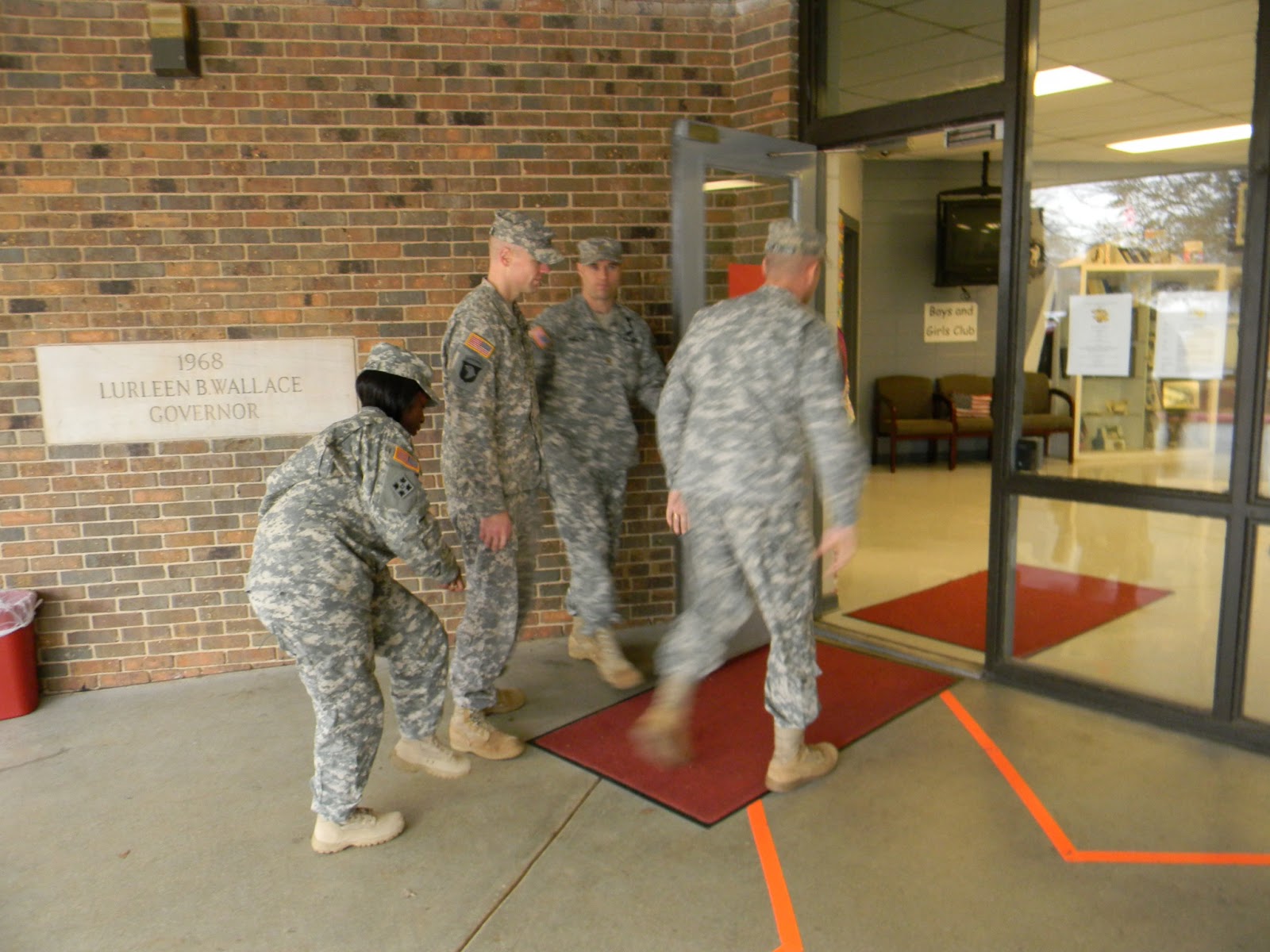
Once we got in, they let us know which classes still needed readers, and I picked a 2nd grade class to read to. It was pretty funny to see the reaction of the kids when we walked into the classrooms. They all gasped, wide-eyed and excited, and almost immediately started shouting out questions.
For me, the teacher had already set up an old rocking chair at the head of the class. I came in and sat down, and the class sat on the floor in front of me. The teacher asked that I tell the class a bit about myself, so I asked them all their names, and then told them about myself. The kids were most interested in my uniform, so I told them all about what everything meant. They also had tons and tons of questions, which I tried to answer.
Part of the event was that the class was celebrating Dr. Seuss, and the books we were able to choose from were a selection of Seuss books. I chose one of my favorites, "One fish, Two fish, Red fish, Blue fish". (If they had offered "Marvin K Mooney Will You Please Go Now" I would have picked that) It was nice that I've read the book so many times that I've got it mostly memorized. The kids followed along well and while we were reading they were good about paying attention and not interrupting.


After I was finished reading there was more time left and the kids had tons of questions left. At one point they were getting a bit rowdy, and the teacher was struggling to keep them in order, so I jumped in with attention claps. It was hilarious that as soon as I started clapping, the kids instantly straightened up and started clapping in response. I even heard one of them ask another "How does he know this?"
We also had a conversation about what I do, and I explained that I was going to school, and that I'd just come from going to another school. When I asked them what they enjoyed learning, I was surprised at how many of them answered with things like math and reading. I tried to tell them that I kept going to school because there was always something new to learn, and that we are never to old to keep learning.
Overall it was a great experience and I'm glad I got to participate. Kids are great, especially my own kids, of course.
Sunday, March 3, 2013
An Example of Handling Violence in War from the Book of Mormon
So, I thought I'd do something a little different. Each Sunday I'm going to do a blog post outlining some of the lessons I've learned from the war chapters in the Book of Mormon.
For those who are less familiar with the Book of Mormon, it is the scriptural record of a Christian people who migrated from Jerusalem to the Americas around 600 BC. Shortly after arriving, this people split into two groups, the more righteous Nephites and the generally barbaric Lamanites. Over the course of the 1000 year history of the Nephites, there are many wars referenced in the Book of Mormon, but particular attention is given to one specific period of war, approximately 73 BC to 60 BC, and occupies 20 chapters (Alma 43 - 62).
There are some who prefer to kind of skim through these chapters, as it can sometimes seem counterintuitive that a book written "to the convincing of Jew and Gentile that Jesus is the Christ, the Eternal God, manifesting himself unto all nations" (Book of Mormon title page) would give focus to the operational and tactical conduct of a major war. However, I believe that when Mormon abridged the records of the Nephites into what we know as the Book of Mormon, he did so with precision, and that he included the account of this war for a purpose - because he knew that in our day of constant warfare, we would need a scriptural example of how to righteously prosecute wars.
In the beginning of this war, two groups called the Zoramites and Amalekites, dissenters from the Nephite nation, joined forces with the Lamanites and convinced them to go to war with the Nephites. The leader of the Lamanite army, Zerahemnah, intended to defeat the Nephites and subject them to Lamanite rule. The military leader of the Nephites, named Moroni, discovered the Lamanite preparations for war and in turn began preparing his own armies for war.
However, Moroni was what we would call today a "disruptive thinker" and instead of simply arming his troops, he armored them with "breastplates and with arm-shields, yea, and also shields to defend their heads, and also they were dressed with thick clothing" (Alma 43:19). The Lamanites were less than prepared for this, being armed only with their weapons and "they were naked, save it were a skin which was girded about their loins" (Alma 43:20).
So, the Lamanites reevaluated their plans and decided to try attacking another spot, but Moroni was a good commander and he sent spies after them to figure out where they were going. In addition, he sent representatives to their prophet at the time, named Alma, to ask what the Nephites should do to defend themselves. Both the spies and Alma's revelation give Moroni the information he needed to set up a three-way ambush of the Lamanite army in a river valley, with forces on the East, West and South parts of the valley. When the Lamanites marched into the valley, the forces on the West closed the loop behind them and completely encircled the Lamanites, and began attacking. Since the Lamanites were armored by hope and a loincloth, they soon began to retrograde, and the other Nephite armies initiated their attack, and "the work of death commenced on both sides" (Alma 43:37).
Now, in this situation, and knowing that the entire purpose of the Lamanites was domination, and the purpose of the Nephites was defense, Moroni could have easily seen this as an opportunity to completely wipe out the Lamanite armies. However, when the Moroni saw that the Lamanites were "struck with terror" at the realization that they were surrounded and facing likely destruction, Moroni did not use that fear to guarantee the destruction of the Lamanite army.
Instead, he called a cease fire.
The Nephite armies pulled back "a pace" from the Lamanites, and Moroni said, "Behold, Zarahemna, we do not desire to be men of blood. Ye know that ye are in our hands, yet we do not desire to slay you," I can only imagine at this point the Lamanites were very well aware, though, of the Nephites' ABILITY to kill them... Moroni outlines the reasons why the Nephites are fighting, and states that it is the Lord's power and support which gave them power. But then he offers the Lamanites an out, he says "I command you by all the desires which ye have for your life, that ye deliver up your weapons of war unto us, and we will not seek your blood, but we will spare your lives, if ye will go your way and come not again to war against us. And now, if ye do not this, behold, ye are in our hands, and I will command my men that they shall fall upon you and inflict the wounds of death in your bodies, that ye may become extinct, and then we shall see who shall have power over this people."
Zerahemnah agrees to hand over his weapons, and does so directly to Moroni, but refuses to make the demanded oath, knowing full well that it would be broken. Here, Moroni had the opportunity to compromise and accept the immediate tactical victory, and allow the Lamanite army to leave. But he did not. Instead, he says "Behold, we will end this conflict. Now I cannot recall the words which I have spoken, therefore, as the Lord liveth, ye shall not depart except ye depart with an oath that ye will not return again against us to war. Now as ye are in our hands, we will spill your blood upon the ground, or ye shall submit to the conditions which I have proposed."
Zerahemnah takes his sword and tries to kill Moroni, but is stopped by a Nephite soldier, who not only breaks Zerahemnah's sword, but partially scalps him as well, and then uses the scalp piece as an object lesson for the rest of the Lamanites. Some of the Lamanites took the opportunity, made their oath and left, but the rest instead tried to psych themselves up for what they must have known was their final battle.
Seeing that there was no other way to deal with the Lamanites, Moroni gave the order, and the Nephites attacked, routing the Lamanites.
This time, Zerahemnah, realizing his mistake, "cried mightily unto Moroni, promising that he would covenant and also his people with them, if they would spare the remainder of their lives, that they never would come to war against them."
Moroni could very easily have said, "Sorry, Zerahemnah, you had your chance and now you have to live with your decision." Instead, Moroni called cease fire again and let the Lamanites take their oaths and leave.
On Thursday in class we were having a discussion on ethics and American prosecution of war and the discussion turned focused on two factors: first, war is inherently violent and should be prosecuted in the most violent and destructive manner possible in the shortest amount of time, and second, that the US military has a duty to maintain the moral high-ground wherever possible and restrict that violence to matters of military necessity. Essentially, when the US goes to war, we should do so with full purpose and visit violence and destruction on our enemies, but when said violence and destruction are no longer necessary, that we should cease and instead turn away from violence
I immediately thought of this example, where Moroni was willing to use full-scale violence to destroy his enemy, but was able to quickly transition to allowing peace when the opportunity presented itself. Moroni did not glory in the killing and destruction, but in the defense of his nation and his religion. Still, when necessary, Moroni did not shy away from visiting death on his enemies. In the same way, we should not delight in the death and destruction that are inherent in war, yet we should understand that there is a time for everything, including war, and that when necessary, we cannot shy away from visiting our enemies with violence. We just cannot lose ourselves in the destruction and crave the violence.
I know this was a bit long, but I felt the context was important. Here is the seminary video on this topic.
Thursday, February 21, 2013
Tanks From the Skies
In class today I had a bit of a discussion that started out on the topic of the Future Combat System (FCS), which was a failed program designed to beef up the light infantry brigades in the Army and give them more firepower and survivability until heavy armored forces could arrive. Unfortunately the program was hijacked by the "we don't need heavy armor" crowd and became, instead, a program designed to rid the Army of those pesky heavy tanks and Bradleys.
Unfortunately there will always be a need for the firepower and protection of heavy armor, no matter what the lightfighters may say. In fact, the conversation turned to the staying power of US airborne forces, and how the US wasn't the one to get the airborne concept right, but rather the Soviets/Russians. Why? The BMD, and the idea that you can have an airborne armored force.
US airborne forces, such as the 82nd Airborne Division are purely light. When they jump into hostile territory they go in with their boots, their rucks and their rifles. The most firepower you're going to get is going to be from the anti-armor dudes, and then only in the form of an AT4 or a Carl Gustav. A decent punch, but because some poor private's got to not only jump that crap, but carry it around the battlefield, you're not going to have a lot of rounds. Anything heavier, vehicles and heavy machine guns, will be dropped in once the ground is secured, and if armor is coming in, it's not until the air is clear for the C17 or C5 to land and offload.
The Russians, on the other hand, developed an air-droppable light armored vehicle called the BMD (Боевая Машина Десантников), which is tracked, and depending on the version has anywhere from a 74mm gun to a slewed 30mm autocannon and 100mm gun. While in theory they are droppable with crew, in practice, the BMD is dropped out the back ramp of the plane, while the crew and crunchies are dropped out the side doors, all landing at the same time. So, on the objective, on the first pass, you have anywhere from two to six armored vehicles plus infantry. No need to wait for that airfield to be cleared or for the follow on waves to bring you the big toys. The newscast for this first video claims that the crews were actually in the vehicles... Here's some more. The US used to have pseudo air-droppable armor in the form of the Sheridan, as seen here. But even this would still not match the ability to put both crews and tracks on the ground at the same time, alongside airborne infantry. Instead, we got Strykers, without the 25mm guns.
Tuesday, February 19, 2013
Long Weekend
So, last week was spent herding cats. Yep. A group of 16 majors is the equivalent of a herd of cats, but not just housecats... no, imagine that herd contains everything from tabby cats to lynxes and mountain lions. And it was my job to try and put them all to use to create a staff briefing.
The briefing was a pseudo fictional strategic estimate on what the Army calls the GAAT region (Georgia, Armenia, Azerbaijan and Turkey), but the rest of the world calls the Caucasus. A strategic estimate is basically just an information brief that describes the region as it relates to US national strategic and military goals, and gives the same info for the region as a whole as well as each individual nation involved. It is supposed to (according to US joint doctrine) also give recommendations for strategic options, but because of budget cuts, we've taken that part out (J/k).
So, Monday we got about 4 hours to work on this, and then run an IPR (in progress review). Well, let's just say that as the group leader, I got plenty of constructive feedback out of the IPR. Biggest lesson learned is that yes, we're a bunch of majors, but when working together as a staff, you have to issue guidance the same way as you do to your junior soldiers. The reasons are different, though. For the junior soldiers it's to make sure they actually get the info you need. For majors it's to reign them in and keep them from going above and beyond.
Well, I adjusted fire over the next two days and on Thursday, after about 2 hrs of review and finalization, we actually briefed the estimate. Gotta love the Judge, our instructor, who took on the personality of the "I just got here yesterday" boss... but we apparently did a good job of answering his oddball questions and demonstrated an actual knowledge of the area, and the briefing was a success.
So, I rewarded myself with a trip home for Presidents' Day weekend.
It was awesome to see the family again after about 6 weeks, and we had a ton of fun. We went "hiking" at Mount Bunnell, put together a puzzle, ate some good food, and pretty much hung out. By the way, if you're looking for some awesome breakfast in Round Rock, go to Cafe Java in the Randall's complex on AW Grimes and Gattis. Excellent and inexpensive.
Fortunately the only one to really take my leaving hard was Mila, who called me about 15 min after I got to the airport bawling about how she was just going to cry every day until I came home for Easter. She's a sweetheart, and has always been a Daddy's girl.
Unfortunately the weekend is gone, and I've got 6 more weeks till I get to come home again. Sigh...

Sunday, February 10, 2013
On the Russian roads
Some more Russian driving fun. While it's possible this was set up, I can fully believe that the filmers simply set out to see what Russia's roads would offer.
Sunday, February 3, 2013
How not to Testify to Congress
We have to assume that after a few years in Congress, Chuck Hagel would have understood the rules of the "How not to give a media interview" game.
You'd also think that he would have well understood that those same rules apply when testifying before congress.
File this under "How not to testify to congress".
You'd also think that he would have well understood that those same rules apply when testifying before congress.
File this under "How not to testify to congress".
Subscribe to:
Posts (Atom)